

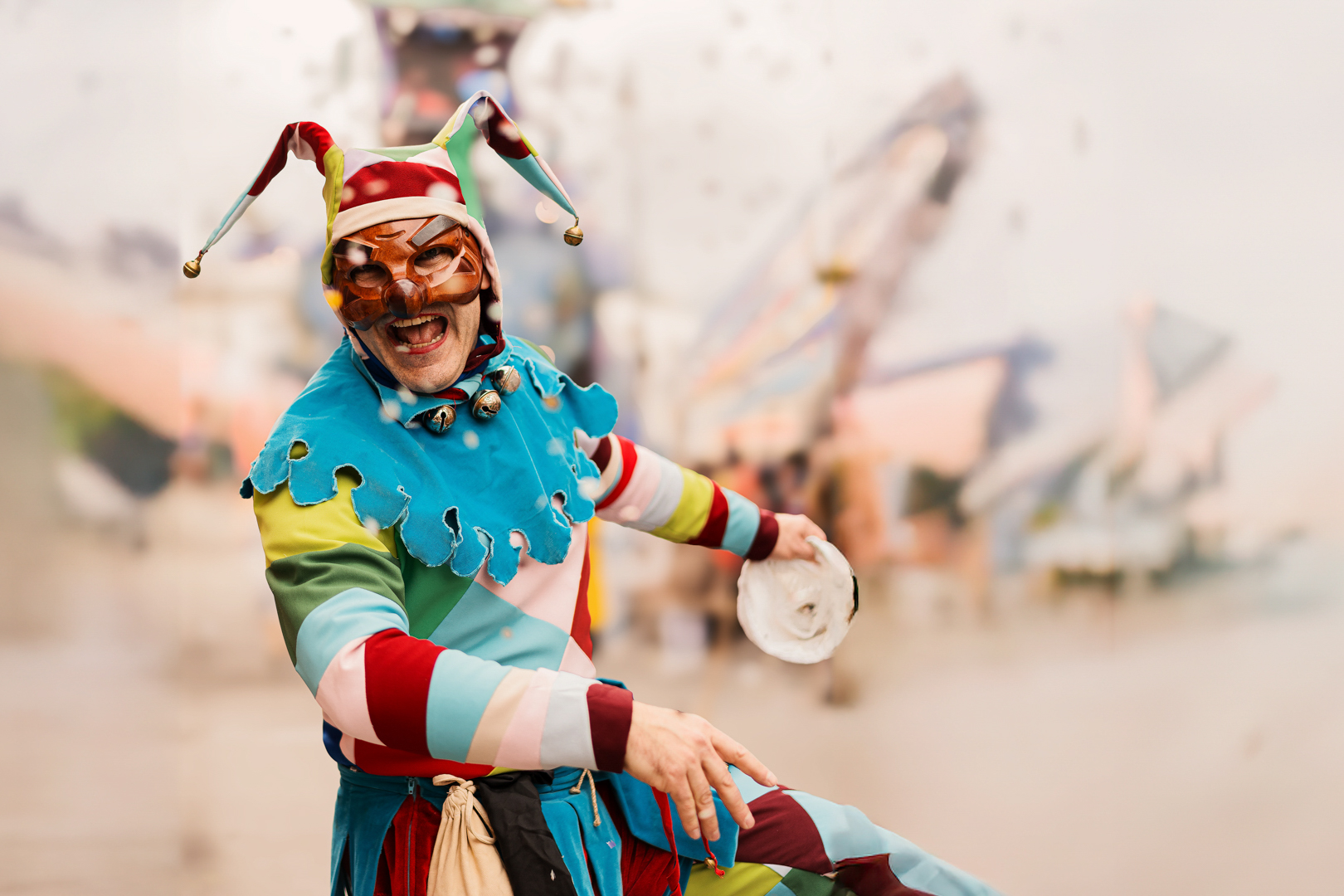
Italian Carnival is famous all over the world not only for its celebrations but also for its traditional masks, which carry stories, meanings and a touch of mystery. From Arlecchino to Pulcinella, each mask represents a part of Italy’s soul, between social satire, humour and theatre. Get ready to discover the secrets of the most iconic masks of our country!
Pulcinella: the irony of the South
Pulcinella, with his hump and his sarcasm, embodies the Neapolitan spirit: cheerful and melancholy at the same time.
- Origin: Born in Naples, Pulcinella was the man of the people who challenged the powerful with irony.
- Costume: White suit, black mask and a pointed hat.
- Did you know? Pulcinella is often linked to Neapolitan proverbs that highlight his cunning and his love of food.
Colombina: the clever, seductive lady
Colombina is the female counterpart of Arlecchino, a smart and determined figure.
- Origin: This mask represents the shrewd maidservant who often solves her masters’ problems.
- Costume: Full skirts, an apron and a fan, symbols of her charm and wit.
- Did you know? Colombina is often at the centre of love intrigues, playing a key role in the comedies.
Pantalone: the rich miser
Pantalone represents the old Venetian merchant, a symbol of greed and stinginess.
- Origin: Born in Venice, he embodies the grumpy old man who clashes with youth.
- Costume: Red suit, a long-nosed mask and a walking stick.
- Did you know? He is often the butt of the other characters’ jokes, becoming a symbol of comedy.
Other iconic masks
- Dottor Balanzone: The emblem of Bolognese learning, but often ridiculed for his arrogance.
- Brighella: The cunning, mischievous servant, in contrast with Arlecchino’s simplicity.
- Farinella: A mask symbolising joy and creativity, taking an active part in the town’s parades and festivities.
- Larinella: The symbolic mask of the Carnevale di Larino, rich in details linked to the traditions of Molise.
Which of these masks is your favourite? Tell us in the comments and share this article with anyone who loves Carnival! Discover many more curiosities on Carnevali d’Italia.